
The problem is not technology. It never was.
I frequently see the same conversation on professional platforms, in boardrooms and conferences: artificial intelligence, automation, digital transformation. The market is flooded with tools.
But when I step off the stage and walk into a real operation, what I find is something else entirely.
Teams that bought software nobody uses. Licenses renewed out of inertia. Indicators that exist on a dashboard but that nobody reviews to make decisions. And people exhausted — not by the work itself, but by the pace of change nobody consulted them about.
According to Gartner, organizations waste nearly 70% of their technology investment due to lack of real adoption. Not due to lack of budget. Due to lack of operational structure.
That is not a human resources problem. It is an operational risk. And operational risks are measured, managed and resolved with engineering — not good intentions.
The number nobody wants to see
Companies project a 78% return on their technology investments. The actual average return is 32%.
Those 46 points of difference are not a calculation error. They are the cost of something nobody is measuring.
This is not a new problem. Organizations of all sizes and sectors repeat the same pattern: buying technology without preparing the operational structure to sustain it. I have seen it in industrial operations, in service companies, in multinationals and in SMEs. Across three continents. The pattern is identical.
The 5 invisible gaps
1. The adoption gap. You bought the software. Does your team use 100% of its features? In most cases, the answer is no. Not because they don't want to, but because the tool was never integrated into the real workflow. It was installed on top of old processes, not embedded in new ones. The result: licenses renewed out of inertia and teams still solving with Excel what the system was supposed to handle.
2. The competency gap. Your team does not have the digital skills needed to operate the new tools. But instead of measuring that gap, the organization assumes a two-hour workshop or a PDF manual solves the problem. It doesn't. It hides it.
3. The digital empathy gap. This is the one nobody measures. It is the quality of human support during the process of technological change. Did anyone ask the team how they feel about the changes? Did anyone measure whether the pace of change is sustainable for the people executing it? When this gap is high, adoption drops, turnover rises and ROI evaporates.
4. The wellbeing gap. Digital stress is no longer an academic concept. Recent studies show that nearly half of workers in high-pressure digital processes report significant burnout — a pattern that repeats across all regions. Exhausted teams do not adopt, do not innovate, do not stay. And replacing them costs between 6 and 9 months of salary per person.
5. The real ROI gap. Companies measure the return on their technology investment without accounting for the four gaps above. They project 78%, achieve 32%, and blame the technology or the team. But the problem is neither. The problem is that they never measured whether the organization could sustain the change.
5 questions to ask yourself today
You don't need a consultancy to know whether your organization has these gaps. You need to ask yourself five questions — honestly:
Is your team using more than 80% of the features of the technology you purchased? If the answer is no, you have an adoption gap.
How many hours of real training — not onboarding — did your team receive in the past year for the digital tools they use? If you don't know, or it's fewer than 20 hours, you have a competency gap.
Did anyone measure the emotional impact of the last technological change on your team? If that measurement was never done, you have a digital empathy gap.
What was the turnover rate of the team that went through the most technological changes in the past year? If it was higher than the company average, you likely have a wellbeing gap.
Does the ROI you report on your technology investment include the costs of turnover, retraining and underutilized licenses? If it doesn't, your real ROI is lower than you think.
If at least two of these questions shook you, your organization likely has gaps that are costing more than you imagine.
A multidisciplinary approach to a global problem
I didn't arrive at these questions from a book. I arrived from the operation.
To understand why organizations fail to sustain their digital transformation, I integrated three perspectives that rarely coincide in the same person:
- The industrial foundation Years leading multifunctional teams — from floor operators to direct coordination with executives and stakeholders at the strategic level — where I learned that a dashboard doesn't fix a broken process. That's where I discovered that technology without operational structure is just an expensive tool nobody uses well.
- The global standard My accreditation as a Professional Engineer by Engineers Australia gave me the rigor of international standards. Project and Program management in Australia gave me the methodology. Strategic data analysis training at Universidad de La Sabana gave me the language of data. And at Harvard BSO, through AI for Business, I understood how operational architectures must be redesigned to integrate artificial intelligence sustainably — not as a patch, but as part of the system.
- The people-centered vision At Expo Osaka 2025 I was selected for the Co-Creation Challenge Team an innovation program where for months I co-created virtually with professionals from more than 150 countries under Society 5.0: the Japanese vision where technology is designed to serve people, not the other way around. And through Remote Work Leadership at Harvard I learned that virtual collaboration fails when culture doesn't sustain technology. That philosophy is not just a concept — it is the way I work.
This intersection — operations engineering, global standards, and the philosophy of Society 5.0 — is what gave life to the Digital Wellbeing Monitor.
What I built to measure it
That question — is your organization transforming at a pace its people can sustain? — is what led me to create the Digital Wellbeing Monitor: a diagnostic tool that measures 5 dimensions of digital transformation with 22 metrics calibrated with data from Gartner, McKinsey, UNESCO, ILO and the World Bank — aligned with the UN Sustainable Development Goals.
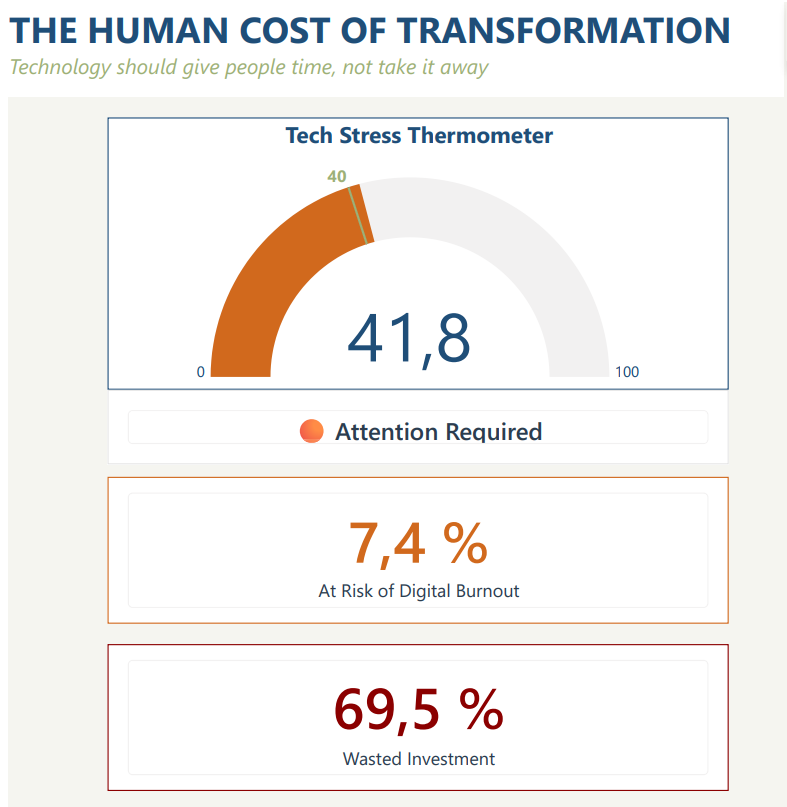
Tech Stress Thermometer — one of the Monitor's diagnostic views.
What you see in the image is only part of it. The Tech Stress Thermometer measures the level of digital pressure on teams. In this case, it reads 41.8 — attention zone. Below, two figures that speak for themselves: 7.4% of the team at risk of digital burnout and 69.5% of technology investment wasted due to lack of real adoption.
But the Monitor goes beyond diagnosis. Its central indicator is the Organizational Adaptability Index (OAI) — a composite metric integrating 5 dimensions, 22 metrics and 11 international sources. It compares regions, identifies gaps by dimension, measures real ROI against uncaptured potential, and delivers concrete action priorities.
It doesn't measure how much technology you have. It measures whether your transformation is sustainable for your operation, your people and your profitability.
Organizations that have seen it discover that between 40% and 69% of their technology investment is at risk — not because of the technology, but because of gaps they never measured.
If this shook you
If any of those 5 questions moved you, your organization probably needs a diagnostic before investing another dollar in technology.
Do you want to know your organization's Organizational Adaptability Index?
Data serves the person — not the other way around.
Paola Serrano
Systemic & Industrial Engineer | Professional Engineer (MIEAust), Engineers Australia
Co-Creation Challenge Team, Expo Osaka 2025 | Harvard Business School Online Community
May 2026
 EN
EN  ES_CO
ES_CO
Great content! Keep up the good work!